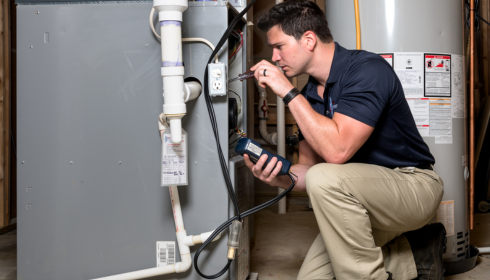
Hot water problems never stay small for long. A failing water heater can interrupt showers, laundry, dishwashing, and business operations in a single day, and in some cases it can lead to water damage, higher utility bills, or unsafe temperature swings. Salmon HVAC provides water heater repair, replacement, and installation throughout Northern Utah for both traditional tank systems and modern tankless units.
Utah homes place unique demands on water heaters. Hard water speeds up scale buildup, sediment settles quickly in tank-style heaters, and winter temperatures make reliable hot water even more important. We help homeowners and small commercial properties choose the right solution for their demand, their space, and their long-term operating costs — whether that means a straightforward tank replacement or an upgrade to tankless.
Water Heater Services We Offer
- Traditional tank water heater repair — Burner issues, failed heating elements, thermostat problems, leaks at fittings, pressure relief valve problems, pilot and ignition issues, and sediment-related performance loss.
- Traditional tank water heater installation — Gas and electric replacement installations, code-required safety components, expansion tank recommendations where needed, and proper venting and drain-pan setup.
- Tankless water heater repair — Flow sensor problems, ignition failures, scale buildup, venting issues, error-code diagnostics, and annual descaling service.
- Tankless water heater installation — Proper sizing for peak hot water demand, gas line and venting review, recirculation guidance, and installation designed for long-term efficiency.
- Replacement guidance — Clear repair-vs-replace recommendations based on unit age, condition, efficiency, and the total cost of ownership.
- Preventive maintenance — Tank flushing, anode-rod inspection, burner cleaning, combustion checks, and tankless descaling to extend equipment life in Utah's hard-water conditions.
Tankless vs. Traditional Water Heaters
Both systems have a place in Northern Utah homes. The best choice depends on how much hot water your household uses, how often multiple fixtures run at once, your available utility connections, and how long you plan to stay in the home.
- Traditional tank water heaters — Lower upfront cost, simpler replacement path, and a strong fit for many homes that want dependable hot water without reworking gas or venting systems.
- Tankless water heaters — Higher upfront cost but longer service life, no standby tank losses, and better performance for homes that want extended shower capacity or want to free up mechanical-room space.
- Utah hard-water impact — Tankless units need routine descaling to protect the heat exchanger. Tank systems benefit from regular flushing to control sediment buildup and preserve recovery efficiency.
- Sizing matters — Tankless systems must be sized to the household's peak flow demand, while tank systems must be sized for storage capacity and recovery rate. We evaluate both before recommending equipment.
Signs You Need Water Heater Repair or Replacement
- Water is not getting hot enough — Often caused by failed elements, burner issues, thermostat problems, or heavy sediment buildup reducing heat transfer.
- Hot water runs out too quickly — A common sign of tank sediment, a damaged dip tube, undersized equipment, or a household that has outgrown the current system.
- Discolored or rusty hot water — This may point to tank corrosion, an exhausted anode rod, or interior rust that often signals the tank is nearing end of life.
- Rumbling, popping, or crackling sounds — These noises usually mean sediment has hardened at the bottom of the tank, forcing the burner to work harder and reducing efficiency.
- Visible leaks or moisture around the unit — Leaks at valves or fittings may be repairable. A leaking tank itself usually means replacement should happen quickly.
- Recurring tankless error codes — Ignition failures, venting faults, and scale-related shutdowns are all signs the unit needs proper diagnosis rather than repeated resets.
Why Water Heaters Fail Faster in Utah
Northern Utah's water quality matters. Mineral-rich water leaves behind scale and sediment inside water heaters over time. In traditional tanks, that buildup settles at the bottom of the tank, creating noise, slowing recovery, and increasing burner stress. In tankless units, the same minerals can coat the heat exchanger and reduce flow, efficiency, and lifespan if descaling is neglected.
That is why maintenance matters more here than in lower-mineral markets. Homeowners who flush tank systems and descale tankless systems on schedule typically see better efficiency, steadier hot water delivery, and longer service life from the equipment.
Our Water Heater Installation Process
- Assess the existing setup — We inspect the current unit, confirm utility type, check venting, evaluate gas-line capacity where applicable, and review hot water demand.
- Recommend the right system — We help you compare tank and tankless options based on performance, budget, and long-term efficiency rather than pushing a one-size-fits-all answer.
- Complete a code-compliant installation — We handle shutoff, removal, connection, venting, temperature and pressure relief setup, and final testing to ensure safe operation.
- Test performance and safety — We verify ignition or element operation, confirm temperature delivery, inspect for leaks, and make sure the unit is operating as designed.
- Walk through maintenance expectations — We explain flushing intervals, descaling recommendations, and the warning signs to watch for as the unit ages.
Why Choose Salmon HVAC for Water Heater Service
- 47 years serving Northern Utah — We understand how local water quality, winter conditions, and older mechanical rooms affect water heater performance and replacement planning.
- Repair-first honesty — If a repair makes sense, we tell you. If replacement is the better financial decision, we explain why clearly.
- Tank and tankless expertise — We work on both styles of equipment, which means recommendations are based on fit, not installer preference.
- Code-conscious installations — Proper venting, safe clearances, temperature and pressure protection, and clean final commissioning matter just as much as the equipment itself.
- Cross-trained home-comfort perspective — Because we already evaluate ductwork, airflow, filtration, and humidification in Utah homes every day, we approach hot water systems as part of the full comfort system, not in isolation.
Frequently Asked Questions
Do you install both tankless and traditional water heaters?
Yes. We repair and install both traditional tank water heaters and tankless water heaters. The right choice depends on household demand, available space, utility setup, and how much long-term efficiency matters to you.
How long do water heaters last in Utah?
Traditional tank systems usually last 8 to 12 years in Northern Utah, while tankless systems often last 15 to 20 years with regular maintenance. Hard water is the biggest factor that can shorten lifespan if flushing and descaling are skipped.
Is a tankless water heater worth it in Utah?
For many homes, yes. Tankless systems can reduce standby energy loss, save space, and deliver longer runs of hot water when correctly sized. They do cost more upfront, and in Utah they need routine descaling to stay efficient.
What are the signs a water heater should be replaced instead of repaired?
If the tank itself is leaking, the unit is near end of life, the repair cost is high relative to replacement, or hot water demand has outgrown the current unit, replacement usually makes more sense. We will walk you through the tradeoffs honestly.
We Serve These Utah Areas
Salmon HVAC provides water heater service and installation throughout Davis, Weber, Salt Lake, and Morgan counties: